

Introduction
In considering the nature of God, from whom all things flow, it is interesting to note how scripture often seeks to emphasize His Triune Nature that consists of the Father, Son and Holy Spirit. While clearly, they are coequal members of the Godhead, there are different roles that each play in terms of Creation / the Fall / and Redemption.
As will be seen, understanding this leads us to a connection with God the Father that numerically leads to a unique end-time timing clue for this year. Again, it may just be another sign that is pointing us to the end, starting with this year as being a pivotal and prophetically transitional year, or it could be the real thing, and Jesus could return. Time will tell, but either way, it is important to understand that Jesus is close, and He is coming very soon, so we need to draw near to Him now, and ensure we are right with Him. Remember Jesus said
42 Watch therefore, for you do not know what hour your Lord is coming. 43 But know this, that if the master of the house had known what hour the thief would come, he would have watched and not allowed his house to be broken into. 44 Therefore you also be ready, for the Son of Man is coming at an hour you do not expect. Matthew 24:42-44
The word 'watch' in Greek is γρηγορεῖτε - it is a Verb that is parsed as: present, active, imperative, second person, plural. Importantly, as an imperative, it is a command, not a suggestion. As such, Jesus is literally commanding believers to watch. In the context of this verse, that is very revealing because it is framed within the idea that believers will know the Day as we see it approaching. This is because it only says here that "...you do not know what hour your Lord is coming", not that you do not know the day (see below for more on this). Within this very narrow frame of reference, that arguably could occur in connection with the Feast of Trumpets, that since the Babylonian exile has a two-day window, Jesus states that the Son of Man will be coming.
I am not claiming that this will definitely happen at that time—only that it is possible. To further support the view that Scripture allows believers to recognize the timing of Christ’s return, within such a narrow window, consider the following examination of Matthew 24:36–44 in light of Matthew 21:23–27. Together, these passages reveal what I believe is the precise kind of vigilance that the LORD expects from those who belong to Him.
Re-examining the Command to “Watch” in Matthew 24:36
When reading Matthew 24:36–44, commentators almost universally lean on verse 36 (“But of that day and hour knoweth no man”) as a blanket proof that the timing of Christ’s return is entirely cloaked in mystery. However, a strict adherence to the immediate context, translation history, and the historical setting reveals a far more precise, narrowing progression. In verse 36, “day” (hēmera) and “hour” (hōra) are paired to establish a literal calendar timeline. By the basic rules of hermeneutics, a word cannot completely shift its semantic baseline mid-discourse, without explicit textual markers. Therefore, when Jesus reaches verses 42 and 43, his use of the word hōra (for hour) cannot legitimately be broadened into a vague metaphor for a general "season" or "epoch." If Jesus meant an era, the Greek language offered perfectly adequate vocabulary, such as kairos. By maintaining hōra, the syntax deliberately binds the discussion to a specific division of a literal day, and that day could be one of the two days that in the modern era are connected with the Feast of Trumpets.
To fully unlock the translation mechanics that allows this possibility, we can look just three chapters earlier to a fascinating translation choice in the King James Version (KJV). In Matthew 21:23–27, an interplay unfolds between Jesus and the Chief Priests regarding His authority. Initially, the dialogue revolves around "telling," powered by the root word legō (λέγω). The underlying logic is clear: both parties know the truth, and if the priests will "tell" (legō) what they know about John's baptism, Jesus will "tell" (legō) them of His authority. Realizing they are trapped, because any answer will undermine their position, the priests declare in the Greek text: ouk oidamen (οὐκ οἴδαμεν) —"we do not know". They attempt to claim a lack of internal knowledge to avoid an external disclosure. Interestingly, the KJV renders this exact phrase not as "we do not know," but as "We cannot tell." By using "tell," the KJV subtly frames their response as an act of defiance —as if they really do know, but refuse to speak. Modern translations like the NIV and ESV correct this by rendering it literally: "We don't know."
IMPORTANT - This semantic overlap between 'Tell' and 'Know' becomes profound when we return to Matthew 24:36. The verb translated as "knows" is oiden (οἶδεν)—the singular form of the exact same root word (oida) used by the priests. So importantly, if oida can legitimately carry the functional weight of "telling" or "making known" (as the KJV translators demonstrated in chapter 21), then verse 36 can legitimately be translated as "tell' as well. Doing so sees it take on a beautiful context. It reads less like an absolute statement of ignorance and more like a declaration of authority: "No one tells/reveals that day and hour... but the Father only." This perfectly aligns with the ancient Jewish wedding custom —a theme Jesus reinforces in John 14— where the groom builds a chamber at his father's house, but only the father has the ultimate authority to tell the son when the time is right to go and gather his Bride.
This specific focus is heavily reinforced by the historical context of the thief analogy in verse 43 of Matthew 24. In the ancient Greco-Roman and Jewish world, the night was systematically divided into strict, operational blocks of time known as “watches” (phylakē). The logic of the analogy depends entirely on this narrow timeframe. If a homeowner (oikodespotēs) is merely told a thief is coming on a certain day, he has a massive 24-hour window that leaves him vulnerable. But if he knows the thief is coming on that day, his vigilance concentrates intensely on the precise phylakē of that night. Jesus’ illustration breaks down entirely if a “watch” is interpreted as a long, vague era; the analogy demands that the homeowner understands the general timeframe, but must stay actively alert for the precise watch.
This textual flow reveals a profound shift from a broad unknown to a highly concentrated window of readiness. While verse 36 seems to begin with an absolute unknown due to a translation choice, the preceding verses concerning the fig tree (vv. 32–33) provide a context that explicitly states that observing the signs allows believers to know when the event is "even at the doors." Consequently, as the signs unfold, the broad proximity of the day becomes something the faithful are expected to recognize, particularly as it narrows to within a very small window of time, such as in connection with a Feast of the LORD. What remains hidden—requiring acute, minute-by-minute vigilance—is then only the exact watch of the night.
For us as believers today, this completely elevates the command to watch (grēgoreite / γρηγορεῖτε). It transforms "watching" from a passive, lifelong theological concept into an urgent, high-alert action based on the conditions unfolding right in front of us. If the return of Christ were completely random and unpredictable in every capacity, active watching would lose its logical urgency, fading into a vague, future hope. But Jesus paints a very different picture. Because the overarching timeline narrows as the signs unfold, the command to watch the final hour requires intense, active readiness. We are called to be like that homeowner sitting up in the dark, eyes wide open, knowing the day is here and refusing to let the final watch catch us asleep. So regardless of whether He does return this year, or not, or whether He returns in connection with the Feast of Trumpets, or not, we can see that these are all possibilities now and we should remain vigilant.
With that said, this article will definitely be much shorter than some of my recent ones, as I am only trying to point to this one connection that I have seen in relation to God the Father. However, I first need to establish the Father's role in the Trinity of God, so that we can understand the starting point of what is an intriguing 'mathematical connection' to the Feast of Trumpets this year, that occurs over two days from the 12th of September to the 13th of September 2026.
So, with that said we will now consider that Nature of God and the Trinity.
Nature of God and the Trinity
Firstly, in this respect, it is significant to note that the Triune God wanted those created in His image to understand that while He is one God, He is also three persons, and He chose for two persons of the Godhead to be directly relatable because He revealed them with familial names - Father and Son. The third person was simply revealed as the Comforter or Helper, and the Holy Ghost or Holy Spirit, depending upon your translation.
26 But the Comforter, which is the Holy Ghost, whom the Father will send in my name, he shall teach you all things, and bring all things to your remembrance, whatsoever I have said unto you. John 14:26
26 But the Helper, the Holy Spirit, whom the Father will send in My name, He will teach you all things, and bring to your remembrance all things that I said to you. John 14:26
This is important because it reveals that God wanted us to relate to Him firstly as our Father from whom all things flow and secondly through the Son (Jesus) as our Redeemer and LORD. This is exactly what Jesus was declaring when He stated that He was the Way to the Father:
6 Jesus saith unto him, I am the way, the truth, and the life: no man cometh unto the Father, but by me. John 14:6
Jesus did not say that He was the Way to the Spirit, who would later be sent by the Father, as John 14:26 states above. So, in saying this, He was revealing that He was submitting Himself to the Father's will, to whom He was making a way.
As it also states in 1 Corinthians 15: 24, God the Father has put everything under Jesus' feet, meaning that ultimate divine authority has been given to Him by the Father. Other verses such as Hebrews 2:8, also reference how the Father had laid everything at the Feet of Jesus:
8 Thou hast put all things in subjection under his feet. For in that he put all in subjection under him, he left nothing that is not put under him. But now we see not yet all things put under him. Hebrews 2:8
As such, every power in creation was placed in subjection under Jesus' feet—with the explicit exception of the Father Himself, who granted this authority.
27 For he hath put all things under his feet. But when he saith all things are put under him, it is manifest that he is excepted, which did put all things under him. 28 And when all things shall be subdued unto him, then shall the Son also himself be subject unto him that put all things under him, that God may be all in all. 1 Corinthians 15:24-28
However, after defeating all rule and authority (including death), Jesus presented the completed, redeemed kingdom back to God the Father, and as the Son, He Himself remains subject to Him, so that God may be all in all:
24 Then cometh the end, when he shall have delivered up the kingdom to God, even the Father; when he shall have put down all rule and all authority and power. 1 Corinthians 15:24
Ultimately this occurred at the Cross, as Colossians 2:15 states:
15 Having disarmed principalities and powers, He made a public spectacle of them, triumphing over them in it. Colossians 2:15
While the fullness of this defeat is yet to occur because Satan, though defeated, is still in the world, everything ultimately remains under the sovereign administration of God the Father, who has appointed times for Himself and for Jesus to return and gather His Bride. Importantly this will occur in line with the customs of the Jewish wedding that will involve the Father telling His Son when to go and get His Bride. Meantime Jesus, who will remain in Heaven with the Father until this appointed time, that we are all waiting for, has already been crowned as King of Righteousness. We can see this starting in Daniel 7:13-14, where we get a glimpse of God's activities at the Ascension of Jesus (after the Cross), remembering that Jesus' favorite title for Himself in the Gospels was the "Son of Man":
13 I saw in the night visions, and, behold, one like the Son of man came with the clouds of heaven, and came to the Ancient of days, and they brought him near before him. 14 And there was given him dominion, and glory, and a kingdom, that all people, nations, and languages, should serve him: his dominion is an everlasting dominion, which shall not pass away, and his kingdom that which shall not be destroyed. Daniel 7:13-14
Here, after rising up into the clouds, while His disciples watched on earth, Jesus as the Son of Man came with the clouds to Heaven and came up to the Father (Ancient of Days) seated on the Throne. At this point Jesus delivered up the Kingdom of God to the Father (as it states in 1 Corinthians 15:24), and then the Father gave Him an everlasting dominion, that will never pass away, and both glory and a kingdom, that all people, nations, and languages, should serve him.
So, Jesus, as the Son, submitted everything to the Father and then the Father gave it all back to Him, such that everything for all time would be in submission to Him, and God would be all in all. Other verses also explicitly state that Jesus' kingdom and reign have absolutely no end, continuing long after the submission event of 1 Corinthians 15.
• Luke 1:33: "and he will reign over Jacob’s descendants forever; his kingdom will never end."
• Hebrews 1:8: "But about the Son he says, 'Your throne, O God, will last for ever and ever; a scepter of justice will be the scepter of your kingdom.'"
• No Demotion: Jesus submitting to the Father is a display of perfect relational harmony within the Trinity, not a loss of divinity or status.
• Shared Inheritance: Because Jesus is God, when the Kingdom is handed over to God the Father, it is handed over to the Triune Godhead. Jesus, as the Son, inherently rules over it.
• Eternal Inheritance: Hebrews 1:2 states that the Father appointed the Son "heir of all things." An inheritance in biblical terms is a permanent possession.
Then the final chapters of the Bible describe the "Age to Come" (the New Jerusalem and Eternity). They do not show Jesus stepping down; instead, they show that the Father and the Son sharing the ultimate throne together.
• Revelation 22:1: "Then the angel showed me the river of the water of life... flowing from the throne of God and of the Lamb."
• Revelation 22:3: "The throne of God and of the Lamb will be in the city, and his servants will serve him."
• Revelation 11:15: "The kingdom of the world has become the kingdom of our Lord and of his Messiah, and he will reign for ever and ever."
Therefore, Jesus delivers the kingdom to the Father to mark the official end of sin, death, and rebellion. Once that order is fully established, near the end of the Tribulation, the Father and the Lamb will then rule over that redeemed universe together forever.
Thus, the reference to all things being put under Him is imagery that portrays the ultimate divine authority given to Christ by the Father, where every power in creation is placed in subjection under Jesus' feet—with the explicit exception of the Father Himself, who granted this authority.
Ultimately, Jesus as the King of Righteousness will rule forever on the Throne of David from the new Jerusalem that will come down from Heaven to a new Earth as described in Revelation 21:
1 Now I saw a new heaven and a new earth, for the first heaven and the first earth had passed away. Also there was no more sea. 2 Then I, John, saw the holy city, New Jerusalem, coming down out of heaven from God, prepared as a bride adorned for her husband. Revelation 21:1-2
Similarly, with respect to the Spirit of God, we see that though He as the third person of the Godhead is coequal to the Father and the Son, He submits Himself to both, and seeks no attention for Himself. Notable New Testament scholars such as F. Dale Bruce and J. I. Packer and others have popularized the idea that the Spirit is the "Shy Member of the Trinity" because He refuses to self-aggrandize. Bruner also suggests that this "shyness" or humility reflects the inner life of the entire Trinity, where each person eternally defers glory and points to the others. This is described in John 16:13 where Jesus declared that Spirit would not speak of Himself, but only whatsoever He hears (from the Father and the Son):
13 Howbeit when he, the Spirit of truth, is come, he will guide you into all truth: for he shall not speak of himself; but whatsoever he shall hear, that shall he speak: and he will show you things to come. John 16:13
Essentially, because God is “all in all,” whenever you worship the Father, you also honor the Spirit who reveals Him. The historic, global Church affirmed this truth in the Nicene Creed, declaring that the Holy Spirit “with the Father and the Son together is worshipped and glorified.” We are not overlooking the Spirit when we praise Jesus through the Spirit’s power, the Spirit is perfectly honored and fully glorified in that moment.
Basically, whenever God acts, all three Persons are involved, but one Person may be the "manifest face" of that action. In this respect, Scripture shows that when the Father speaks, He speaks through His Word (the Son) by the power of His Breath (the Spirit). And when Jesus was on earth, the Father was intimately present in Him, and the Spirit empowered Him. They were never truly separated, even when Jesus felt the agony of abandonment on the Cross, which was a relational weight of bearing Sin, not a spatial rupture in the omnipresent Godhead.
Examples of this include:
• The Baptism of Jesus: The Father speaks from heaven, the Son stands in the water, and the Spirit descends as a dove. They are acting in total unison, but manifesting in separate ways so we can perceive the relationship between them.
• In the vision in Daniel 7: referenced above, we see that the Ancient of Days sits on the throne (representing the Father, the ultimate authority and source of the Godhead, while the Son of Man approaches on the clouds (representing the incarnate Savior receiving the kingdom.
Ultimately though it was all about making a "Way back to the Father" for when we are connected to Him, we enter into the full fellowship of the Father, Son and Holy Spirit.
This is why throughout the New Testament it is demonstrably so that the majority of prayers are directed toward the Father, who is often just referred to as God. Occasionally some are directed to the Son, but there is not a single instance of one being directed to the Holy Spirit. In a sense to do so would be an oxymoron because it is the Holy Spirit within us who initiates the desire to pray in the first place. As such, He both prompts us to pray and then assists us to pray, as described in Ephesians 6:18, where we are exhorted to pray in the Spirit on all occasions with all kinds of prayers and requests:
18 Praying always with all prayer and supplication in the Spirit, and watching thereunto with all perseverance and supplication for all saints; Ephesians 6:18
Essentially to do so requires us to quiet ourselves before God and as the Holy Spirit leads us, begin to pray. The Holy Spirit will then point our hearts and attention to the Father, through the Son, as Jude 1 shows:
20 But you, beloved, building yourselves up on your most holy faith, praying in the Holy Spirit, 21 keep yourselves in the love of God, looking for the mercy of our Lord Jesus Christ unto eternal life. Jude 1:20-21
It is then the Father through the Son by the Power of the Holy Spirit who begins to sanctify us in preparation for the Mercy of the Lord Jesus Christ, that I showed in my last article has a connection to the number 78, for the term 'His Mercy' has possible end-time connections (click here to read more about that) with the Rapture of the Church, that will see us changed in the 'blink of an eye' to our new eternal bodies.
Occasionally some prayers can be directed straight to Jesus as Lord. A few examples include:
• Stephen, during his martyrdom in the Book of Acts 7:59:
59 And they stoned Stephen as he was calling on God and saying, “Lord Jesus, receive my spirit.” Acts 7:59
• Peter’s Desperate Cry on the Water:
In Matthew 14:30, when Peter was sinking in the Sea of Galilee, he cried out directly to Jesus, shouting, "Lord, save me!
• The Thief on the Cross:
In Luke 23:42, the criminal crucified alongside Jesus addresses Him directly with a petition:
42 Then he said to Jesus, “Lord, remember me when You come into Your kingdom.” Luke 23:42
• Paul’s Appeal to Jesus:
In 2 Corinthians 12:8, the Apostle Paul explicitly states that he pleaded with Jesus regarding his "thorn in the flesh," writing: "Three times I pleaded with the Lord to take it away from me." (The context shows "the Lord" here refers to Jesus, who responds to Paul in the next verse).
8 Concerning this thing I pleaded with the Lord three times that it might depart from me. 9 And He said to me, “My grace is sufficient for you, for My strength is made perfect in weakness.” 2 Corinthians 12:8-9
• The Final Invitation:
The very end of the New Testament closes with a short prayer direct to Jesus in Revelation 22:
20 He who testifies to these things says, “Surely I am coming quickly.” Amen. Even so, come, Lord Jesus! Revelation 22:20
However, God never gave us any examples of praying directly to the Holy Spirit, which maybe why God chose not to reveal a familial name for the third person, who always directs our attention, whether for supplication or for worship, to the Father and the Son. Either way, when we do pray to God as our Father or to God the Son as our LORD and Redeemer, we stand on strong biblical ground.
Ultimately this is all important because it elevates God the Father to His rightful position and it reminds us of His identifying role within the Godhead, where He is revealed as the source of all things. Again, the three persons of the Godhead are coequal —Father, Son, and Holy Spirit—are so completely united in love, essence, and omnipresence that they mutually indwell one another. They are distinct, but they can never be divided, separated, or isolated from each other. To glorify one is to glorify all three, so at no stage, by recognizing the distinct roles of the three, are we elevating one person in essence above the other, we are simply recognizing how the Triune God wants Himself to be interacted with; and clearly the Triune God wants us to acknowledge 'God the Father', as the source of Creation.
As it states in Hebrews 1: 1-2 He made the world through His Son:
1 God, who at various times and in various ways spoke in time past to the fathers by the prophets, 2 has in these last days spoken to us by His Son, whom He has appointed heir of all things, through whom also He made the worlds; 3 who being the brightness of His glory and the express image of His person, and upholding all things by the word of His power, when He had by Himself purged our sins, sat down at the right hand of the Majesty on high, 4 having become so much better than the angels, as He has by inheritance obtained a more excellent name than they. Hebrews 1:1-4
The Father as the Source of Everything
Understanding that the Father is ultimately to be recognized as the source of all things opens us up to something quite interesting, which can be seen in John 15:1 where Jesus refers to the Father, in the King James Version (KJV), as the "husbandman":
1 I am the true vine, and my Father is the husbandman. 2 Every branch in me that beareth not fruit he taketh away: and every branch that beareth fruit, he purgeth it, that it may bring forth more fruit. John 15:1-2
Calling God a 'husbandman' here means that He is like a divine farmer who actively owns, tends, and cares for His spiritual vineyard to produce a harvest. In the New Testament, the Greek word for husbandman is γεωργός (georgos), which literally means a worker of the earth, or a vinedresser.
Jesus uses this word to show how the Father, who is the owner of a vineyard, is the ultimate source of the Vineyard that is the space (heaven and earth) that God the Father provided through the Son, where the Vine is planted and grows. This relates to Jesus (the true vine) and to believers (the branches attached to the vine).
What makes this connection to God the Father as the husbandman particularly interesting is its Hebrew equivalent אִכָּר (’ikār), which is again translated as "husbandman" in the KJV, and is designated as Strong's Hebrew Bible Number 406.
This is a truly significant number because of its connection to the Hebrew word תָּו (tāv), pronounced as Tav, that is the name of the final letter of the Hebrew Alphabet (remembering Jesus said He is the Alpha and the Omega, and this letter is the Hebrew equivalent of the Greek Omega - so it is a pointer to Jesus), and that as the following table shows, it carries the Hebrew Gematria value of 406:
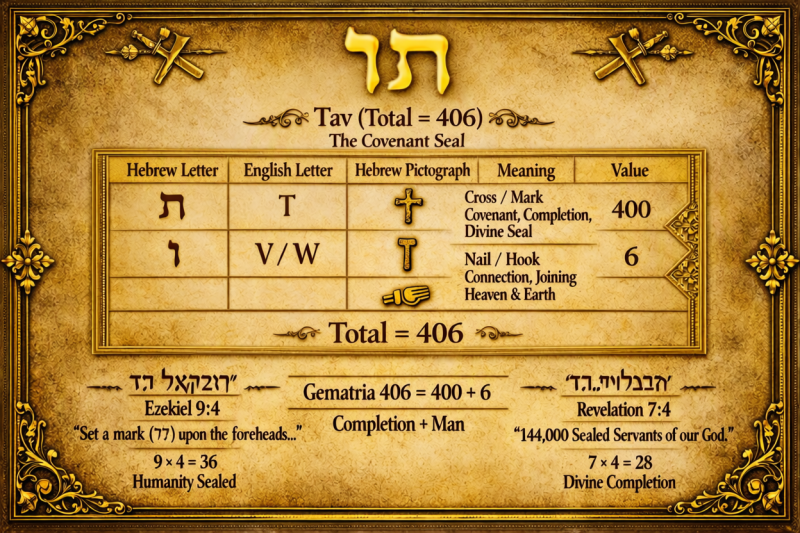
Importantly, as the Hebrew Pictograph above also shows, the meaning of this letter is a Cross or Mark. As such it is connected directly with God's New Covenant that is established in the blood of Jesus on the Cross.
Significantly, this word occurs precisely 7 times, as the following screen shot of the Logos Bible Software shows:
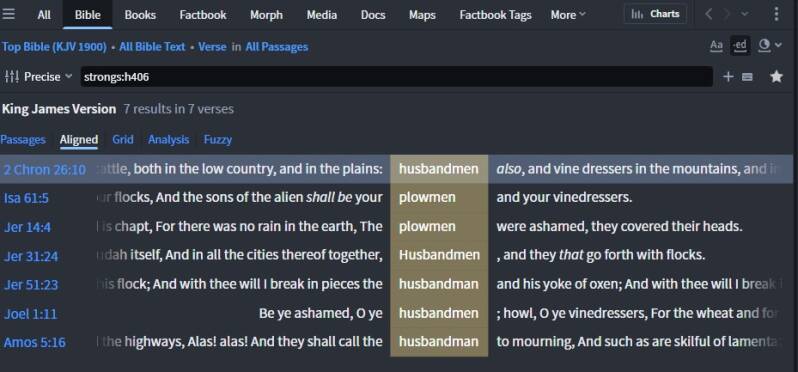
This is amazing because it introduces another connection with God's Covenants that were all founded in connection with the number 7.
In fact, in the ancient world, to cut or establish a covenant was also known as "sevening oneself" because it involved an unbreakable oath which is the word שָׁבַע – Shava, or Oath or Promise, that comes from the same root word for Seven - שְׁבַ֥ע – Sheva, or Seven. The connection between these words, shows that when God does something in a pattern of 7s, He is literally giving His oath to fulfil it – it is His promise. Notably, the word for Sabbath - שַׁבָּת (Shabbat), is also related to these two words, sharing two out of three of the root word's consonants (Shin - ש and Beth - ב). It carries the meaning of stopping and resting, once something is completed, explaining how it became connected to the 7th Day of Creation, when God stopped creating and rested.
So, God the Father, who is the source of all things, swore an oath when He established His Covenant with Abraham, that was essentially a promise to send His Son to atone for the Sins of the World, although Abraham did not fully understand that, in his day. Importantly, תָּו (tāv) is connected theologically to the term "husbandman" through the Hebrew word אִכָּר (’ikār) that in the Strong's Bible Dictionary is assigned the number 406. Then in Hebrew Gematria (406) this number is seen to be equal to the value of the word תָּו (tāv) that at its core symbolizes both a mark and a Cross, the very symbols that would represent this Covenant, that would involve the atoning sacrifice of God's Son being marked, when He was nailed to the Cross of Calvary.
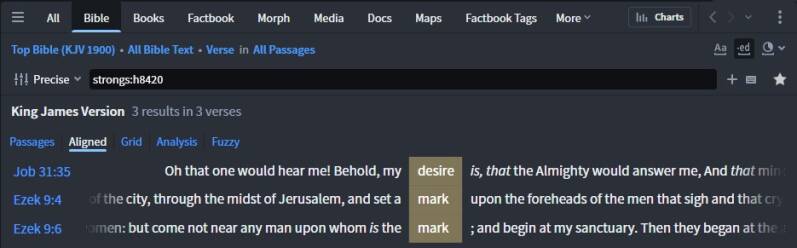
Amazingly, this word only appears 3 times, so in both of these connected words for "husbandman" - אִכָּר (’ikār) and "mark or Cross" - תָּו (tāv), that together connect God the Father (the husbandman) who sent His Son (the true vine) to establish the new Covenant in His blood, through the mark of the Cross, we see both of God's personal numbers 3 and 7 take center stage:
3 - תָּו (tāv)
7 - אִכָּר (’ikār)
The combination of 3 and 7 or 37 is God's personal seal on the connection that takes on extra meaning, as we consider the 3 references to the mark of the Cross, in the word תָּו, which as shown in the screenshot above include:
Job 31:35
Ezekiel 9:4
Ezekiel 9:6
1) Job 31:35:
Firstly, in relation to Job 31:35, we need to understand the following verse in context:
35Oh that one would -- hear me! behold, my desire is, that the Almighty would answer me, and that mine adversary had written a book. Job 31:35
Here the word Tav - תָּו is uniquely translated as desire and it comes in the context of Job lamenting his troubles and trying to reconcile how they could be happening, given that he has lived his life with God's righteousness before his face, and has always sought to walk in total obedience. Essentially Job, in what is generally understood to be the oldest book of the bible, believed the general principle of blessings and curses, that God first laid out to Cain in the Garden of Eden, in relation to obedience:
6 And the LORD said unto Cain, Why art thou wroth? and why is thy countenance fallen?
7 If thou doest well, shalt thou not be accepted? and if thou doest not well, sin lieth at the door. And unto thee shall be his desire, and thou shalt rule over him. Genesis 4:6-7
Here Sin is also seen in the context of having desire.
Later this was specifically formalized in relation to God's chosen people (Israel), who through Moses were specifically told that obedience brings blessings and disobedience brings curses.
1 “Now it shall come to pass, if you diligently obey the voice of the LORD your God, to observe carefully all His commandments which I command you today, that the LORD your God will set you high above all nations of the earth. 2 And all these blessings shall come upon you and overtake you, because you obey the voice of the LORD your God: Deuteronomy 28:1-2
and
15 “But it shall come to pass, if you do not obey the voice of the LORD your God, to observe carefully all His commandments and His statutes which I command you today, that all these curses will come upon you and overtake you: Deuteronomy 28:15
Therefore, in seeking to understand his current troubles, in light of how he has lived his life, there is no doubt about why Job's suffering would have been confusing for him. For even God states in the opening verse of the book of Job:
1 There was a man in the land of Uz, whose name was Job; and that man was perfect and upright, and one that feared God, and eschewed evil. Job 1:1
I do not know of anyone else that God has ever said that of —apart from Noah, who God described as a just man, perfect in his generations— so when we get to verse 35, where the first use of the word תָּו (tāv) occurs, we see it expressed as a desire by Job for God to answer why, as a righteous man, he is suffering.
Unknown to him, God's answer is given in the question itself, because from our vantage point we can see that the תָּו (tāv) that points to the Cross is precisely about God's desire to provide a solution for suffering and His answer was to provide the most perfect Holy and sinless person in His very own Son. Like Job, Jesus was completely innocent, but because He was also the perfect Son of God, He would take Job's righteousness to an incomparable level. For as righteous as Job was, He still needed a Savior and as bad as Job's suffering was, it would be as nothing in comparison to that of Jesus, who would suffer and die for the Sins of every person that ever lived, for all time.
In this way, Job was chosen to reveal God and His Saviour to an ancient world before Christ had come —as well as being a witness to Satan that God's image bearers could love Him simply for who He is, even if they were not being blessed— and while the word was used to reveal Job's desire to understand and escape his suffering, it was also hiding a connection that showed it was God's desire to actually embrace the suffering of humanity so that He could redeem us to Himself. In doing so, the Son of God would literally be marked, as He was nailed to the Cross. He would be the only truly Righteous one atoning for the unrighteousness of fallen man, in a display of mercy and grace that on many levels is incomprehensible. Job's desire to understand suffering met with God's desire in one word that pointed to the Cross, where suffering for all time was dealt with. It is said to be the place where Mercy and Justice Kiss.
Thus, the problem of Sin and its hidden solution in the Cross are pointed to by the numbers of this reference in the book of Job, that involves the numbers 31 and 35, that combine as follows:
31 + 35 = 66
66 is also 6 (man) x 11 (Sin of Man - with the Antichrist being described as the 11th Horn in Daniel)
2) Ezekiel 9:4:
Then the word appears in Ezekiel 9:4, as the Mark of the Cross that is to be put on those who are ultimately going to be saved from God's wrath, which contextually was related to the impending destruction of the Temple and Exile of God's people to Babylon.
4 And the LORD said unto him, Go through the midst of the city, through the midst of Jerusalem, and set a mark upon the foreheads of the men that sigh and that cry for all the abominations that be done in the midst thereof. Ezekiel 9:4
This principle is reflected again in Revelation 7 when God is dealing with the people during the Tribulation, showing that to be saved involves God marking and sealing those that are His:
3 Saying, hurt not the earth, neither the sea, nor the trees, till we have sealed the servants of our God in their foreheads. Revelation 7:3
With reference to the word Tav - תָּו in Ezekiel 9:4, the numbers 9 and 4 or 94, can also be understood as 47 x 2. As I have shown before, this is connected to God's Promises (47) that are made available to us through the second person of the Godhead in Jesus (2) and so can also be reflected in a possible end-time timing clue:
47 x 74 (its mirror number) = 3478
94 x 37 (God's Personal Number) = 3478
God's greatest promise is freedom—both freedom from sin and deliverance from a world that has rejected Him. We see this pattern in history: precisely 470 (47 x 10) years after the covenant promises were given to Abraham, God brought about the Exodus from Egypt. In a similar way, if we begin at this same historical point—1446 BC—we find the following numerical connection using the numbers from the reference containing the word associated with those who are marked by the Cross:
1446 BC + 3478 = 2033 — adjusted to account for there being no year 0
If 2033 were to mark the fulfillment of another exodus for God's chosen people, Israel, it would align with the Second Coming of their Messiah, Jesus. This would place the Rapture, which is believed to occur seven years earlier, in:
2033 - 7 = 2026
This is simply a pattern connected to 94—a multiple of 47 (God's promises)—that suggests this outcome is possible, not that it will necessarily occur in this way.
So, in the first two of the three appearances of the word Tav - תָּו, that points to the Cross, we move from the Sin problem described in Job 31:35, that hints at a solution through God's promise in Ezekiel 9:4 to save those who are marked with the sign of the Cross. Not only that, but we also have a possible clue that points to this year (2026) as a possibility of a solution.
3) Ezekiel 9:6:
Now when we consider the third instance of it in Ezekiel 9:6:
6 Slay utterly old and young, both maids, and little children, and women: but come not near any man upon whom is the mark; and begin at my sanctuary. Then they began at the ancient men which were before the house. Ezekiel 9:6
we see here that the ultimate fulfilment of the desire of God, who promised to save us, is for Him to dwell with us, as the numbers 9 and 6 or 96 can also be understood as 48 x 2 = 96 and 48, and as I have shown numerous times 48 is connected with the presence of God for it was seen...
• when Moses was instructed to build the Holy of Holies in the Tabernacle —that would house the Ark of the Covenant, above which God's presence would dwell— out of 48 boards.
• later 1 Kings 6 describes the building of Solomon's Temple (God's Sanctuary as described in this verse), where God's manifest presence again dwelt, as being 480 (48 x 10) years from the Exodus of Egypt when God set His people free to come and meet and worship Him. And then He had walked and dwelt with His people throughout their Wilderness wanderings, visibly appearing in the pillars of Fire and Cloud.
So here we now have three references to the Word Tav - תָּו that together represent:
• Revelation of Sin Problem - which shows us our need for a Saviour
• Gods promise - to deal save and deliver His people that turn from their Sin
• Gods presence - that comes in conjunction with judgement and salvation, just as it will in the Rapture.
It is a thematic progression that takes us from the Fall of Man through the Cross to the time when Jesus will return so that we can dwell forever in His presence, with the Father.
The Mathematical Link to the Return of Jesus
Significantly, given that this word with the value of 406 can be understood as contextually revealing the problem of Sin and God's promised solution to it, that will lead us into His presence, it is notable that the number 406 mathematically is also the 28th Triangular Number T₂₈ that is calculated using the standard formula for Triangular numbers (Tn = n(n+1)/2) as follows:
T₂₈ = 28(28+1)/2 = 406
Thus, everything that is leading us towards the return of Jesus, in association with the number 406, connects us both thematically and mathematically with the number 28 that —as was dealt with in my last article (Is Isaiah God's Hidden Roadmap to the End?)— was the number that the New Testament specifically connected to the Coming of Jesus (His First Coming to be our atonement).
This was shown by Matthew, in his Gospel, making such a point about 14 generations and showing that Jesus, who came to establish the New Covenant in His Blood, was the 28th generation from Abraham, to whom all the Covenant Promises were given. Additionally, Solomon, in his book Ecclesiastes, revealed that Time itself can be broken up into 28 Seasons, that are detailed as being a "time for every purpose under heaven" in Ecclesiastes 3:1. Then in the next 8 verses (the number of Jesus) he lists what each time represents, concluding with the 28th being a "time of peace", such as one would expect when Jesus comes to gather His Bride unto Himself.
So, through Scripture, which reveals God the Father as the source of all things and the husbandman, we are led to the Hebrew word אִכָּר (’ikār) with the same meaning, that is designated the Strong's Bible number 406. This creates a numerical connection to another Hebrew word, תָּו (Tav)—literally the final letter of the Hebrew alphabet, signifying 'the end'—because it carries a Hebrew gematria value of 406. Together, these affirm the Father’s desire [the husbandman's - אִכָּר (’ikār) desire - תָּו (Tav) ] to deal with Sin, making a way for humanity to draw near to Him and dwell with Him forever because the word תָּו (Tav) means a Mark and a Cross. Essentially, it is symbolically pointing to all who will be marked with the sign of the Cross and be saved. Then, mathematically, we saw that the number 406 points to 28, a number Scripture associates with both the fullness of time and the Coming of Jesus.
Amazingly, when we consider all of this, the question naturally arises:
What is the most clearly stated time period that Scripture itself associates with the Coming of Jesus?
As scripture reveals Jesus coming in two phases - the Rapture and the Second Coming, the answer is telling because there is literally only one time period, known as Daniel's 70th Week a.k.a. the 7-year Tribulation, that is the last 7 years of Daniel's 70th Week, that is also known as the Time of Jacob's Trouble, that connects with both of these phases.
The Rapture connects to the beginning of this time period, and the Second Coming is associated with the end of this same period. So, in the context of this discussion, we can say that the fulness of Time, as represented by the 28 seasons, is prophetically connected to Daniel's 70th week. This is truly significant because this time period also has a numerical representation, with scripture affirming in several places that it will be for 2520 days.
In this way 28 and 2520 are numerically and thematically connected, both in terms of the fulness of time and of God's sovereign plan to save all who will put their faith in Jesus by the time He Returns. So, from this perspective it is interesting to note what you get if you divide the number of seasons within time (28) into the period that ultimately represents the fulness of God's time (2520) covering both the Rapture and the Second Coming, before He establishes His Millennial Reign of Christ:
2520 / 28 = 90
Here we have the number 90 that mathematically represents a pointer to the end, that is essentially 28 stages of 90 that symbolically lead us to the time period beginning with the Rapture - Daniel's 70th week.
Significantly, because the Triune God does things in threes, He also constantly reveals important things through Triangular Numbers.
Some examples include the numbers:
153 (the great catch of fish representing Salvation in John 21) being the 17th Triangular number (associated with the Day Jesus was resurrected from the dead).
666 (representing the Antichrist) being the 36th Triangular Value, that is also connected with Man's Sin.
120 (the limit of God striving with fallen mankind) being the 15th Triangular number that is associated with the Grace of God until that Limit is reached, just to name a few examples.
So. clearly, the Triangular Value 406 carries great significance. As discussed, it is numerically associated with the Cross of Jesus through the Hebrew word תָּו (Tav); and as the value of the 28th Triangular Number T₂₈, it represents the coming of Jesus in connection with the Tribulation.
It is all connected, unfolding as part of God's sovereign plan. This plan can seemingly be divided into groups of 90 (90 x 28 = 2520), representing the fulness of Time. Likewise, 90 may be understood as a Triangular Number, based on the standard formula Tn = n(n+1)/2, as follows:
T90 = 90(90+1)/2 = 4095
In this way, Scripture reveals God the Father as the Husbandman, from whom all created things flow, including the plan of Redemption. Numerically, we see it as a progression from the Triangular Value 406 (the 28th Triangular Number), associated with Jesus' first coming and His death on the Cross, to the Triangular Value 4095 (the 90th Triangular Number) at the end of time.
The Mathematical Connection to the Feast of Trumpets
Now for the final connection to the Feast of Trumpets, just as I stated in the Introduction to this article, that takes place this year from the 12th to the 13th of September 2026.
Essentially, it became a 2-day celebration from the time of the Babylonian exile because the exact beginning of the new month depended upon the sighting of the new moon, and uncertainty over when the first crescent would be confirmed led Jewish communities in exile to observe an additional day. This tradition also carries a powerful spiritual theme, as discussed in the Introduction, in that Believers are called to remain watchful and prepared, since the sounding of the trumpet points to a moment that may arrive suddenly. In this way, the two-day observance becomes a reminder that God’s appointed times are not merely dates on a calendar, but a call to faithful expectation and readiness. However, with that said, it is fascinating to note that if you take the numbers involved in the two dates of this Feast, or appointed time, that can be understood in the format of DD/MM/YYYY, then you will get the following:
12/09/2026
13/09/2026
In turn, if you them add up as whole numbers representing the Day; Month and Year of each day, you get the following:
12 + 09 + 2026 = 2047
13 + 09 + 2026 = 2048
Then adding these totals together, you get:
2047 + 2048 = 4095
The result is the number 4095 which, as shown above, is the value of the 90th Triangular Number, that we determined above is part of the timing numbers from the Cross to the Coming of Jesus.
Thus literally, the Plan of Redemption, from the Father through the Son, leads us the 28th Triangular Number with the value of 406. Then understanding that this number's connection to the number 28 is pointing us to the Coming of Jesus —that has two phases known as the Rapture (in the Clouds) and the Second Coming (Physically to earth)— we are led to Daniel's 70th Week (the Tribulation) the time period that is started and ended by these two events. This connects us to the number 2520, that actually defines the length of the Tribulation (being the number of days in this 7-year time period). This then leads us to another Triangular Number (90), in connection with the Tribulation, because 2520 / 28 (the two timing-numbers divided into each other) equal 90, that together symbolically represent the 28 seasons of 90 - (finality (9) fulfilledby the Law(10)), from the Cross until this final 7-years prior to the Millennium.
That is, together these numbers represent the symbolic totality of time from the Cross (as represented by the word with the value 406) before Jesus will return as King of all the earth, in righteousness at the beginning of Daniel's 70th Week (that is defined by the number 2520). So, the period that began with the 28th Triangular Number (406) will end with the 90th Triangular number (4095), with this number, that is arguably connected to the Rapture event, being equivalent to the sum of all the numbers associated with dates of the Feast of Trumpets this year (2026) - [12+9+2026+13+9+2026 = 4095]
What else is interesting, that in my mind certainly gives this all greater significance, is the fact (as I pointed out in my previous article about Isaiah being God's Hidden Roadmap to the end), that two 28th Triangles T₂₈, with the value of 406 each, perfectly overlap each other, as the image below shows, to form the most important Star of all, the I0th Star Number S₁₀ that carries the value of 541 and is called the Israel Star because the name Israel in Hebrew is יִשְׂרָאֵל, that in Hebrew Gematria also has the value 541.
So, the I0th Star Number S₁₀ is the perfect representation of Israel's national emblem, the Star of David, and numerically it reveals God's plan of Redemption because of the way it connects to the Hebrew Gematria values of the Patriarchs and Matriarchs of the Nation of ISRAEL itself (click here for further information on this in another article: The God who Declares the End from the Beginning):
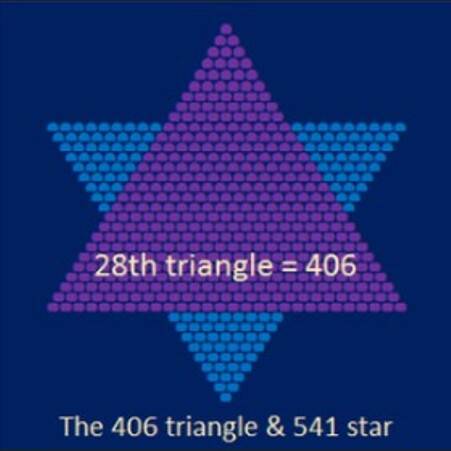
Numerically it is formed as follows:
182 (Jacob) + 307 (Rebekah) + 26 (God's Word to Rebekah) + 26 (God's encounter with Jacob) = 541
Isaac (208) + Rebekah (307) + YHVH (26) = 541
Sarah (505) + Leah (36) = 541
333 (Divinity of God) + 208 (Isaac) = 541
Notably it also connects to the number of the Alpha and Omega (1332), that is a title of Jesus, and the Triune God (3):
3 x 1332 + 541 - 4537
Here it is pointing to the number 4537, which is the value of the 28th Star Number- S₂₈ that is also a numerical pointer to the Return of Jesus (see my previous article "Is Isaiah God's Hidden Roadmap to the End?" for further details on this).
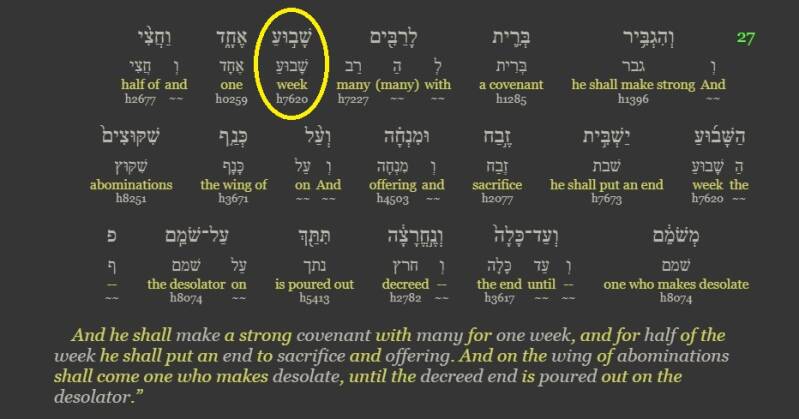
In this regard, it is notable that each of the 6 points on the 28th Star Number- S₂₈ is comprised of 378 dots, or elements. This is particularly notable because there is one instance of the Hebrew word Shavua - שָׁב֣וּעַ (šāḇûa‘) which carries the value of 378, and that is in Daniel 9:27, where it is the word for week that is used in connection with the covenant with the Antichrist, as the verse and the screenshot below both show:
27 Then he shall confirm a covenant with many for one week; But in the middle of the week He shall bring an end to sacrifice and offering.
And on the wing of abominations shall be one who makes desolate, Even until the consummation, which is determined, Is poured out on the desolate.” Daniel 9:27
So again, our numbers that go from 406 → 28 → 90 → 4095 are all connected from the Cross to the Tribulation (and the Antichrist).
∟ 378
And they may be pointing to the dates of the Feast of Trumpets that numerically add up to 4095
Summary
Whether or not Jesus returns in connection with the Feast of Trumpets this year—or at any time this year—it is especially meaningful to consider the biblical connections surrounding the term husbandman (one who owns and tends a Vineyard). The Vineyard portrays God’s Creation, while Jesus is described as the Vine. The central passage is John 15:1–2, where Jesus plainly declares, “I am the true vine, and my Father is the husbandman.”
In Greek, the word is γεωργός, and it is related to the Hebrew word Ikar—אכר—which also means husbandman. Significantly, this term points to God the Father. In the Old Testament, He is seen as the Husbandman (Strong’s H406) who prepared the soil of history by sending His Son to atone for the sins of the world. He did this by sending Jesus in the 28th generation (the root of 406) from the promises given to Abraham, to offer His life on the Cross. This act provided the Tav (Gematria 406)—the cross-shaped mark of complete protection and salvation—for all who abide as branches in the Vine.
In Hebrew Gematria, 406 corresponds to the word תָּו (Tav), which, in Ezekiel 9:4, is the mark of the Cross placed upon those who will ultimately be delivered from God’s wrath. This seems to point to something deeper, because the connection is not merely thematic. The number 406 (husbandman) also has a mathematical relationship to the number 28: 406 is the value of the 28th Triangular Number, T₂₈. Additionally, Matthew emphasizes a pattern of 14 generations to show Jesus’ connection to King David, whose name has a gematria value of 14. In doing so, he also shows that Jesus—who came to establish the New Covenant in His blood—was the 28th generation from Abraham, to whom all the Covenant Promises were given. These connections appear beautifully interconnected and cohesive.
In this way, we see that 28 represents both the coming of Jesus and, as Solomon previously showed, the 28 seasons into which Time may be symbolically divided. Because Jesus’ next coming will be associated with the 70th Week of Daniel—the Tribulation, which will mark the end of this present age—and because Scripture associates that period with the number 2520, there is arguably a symbolic connection to the number 90: 2520 / 28 = 90. This creates bookends for the Age of Grace in the triangular numbers 28 and 90. Then the Triangular value of 90, which is 4095, becomes especially fascinating because it is the exact value of the sum of the numbers in the two dates of this year’s Feast of Trumpets (2026) on the 12th and 13th of September.
Regardless of whether Jesus returns in connection with these dates, the image of the Husbandman and His vineyard remains powerful and deeply personal. It reveals that God the Father is the One who tends, prunes, and cares for the Vine (Jesus) and its branches (believers), while Jesus remains the source of life from whom all true fruit flows. The call to abide in Christ therefore reveals that redemption is not only about being marked for deliverance, but also about being united with the Vine so that the life of the Son flows through all who belong to Him. The Husbandman’s pruning may be difficult at times, but its purpose is loving and fruitful.
God as our Father is always preparing His people to bear more fruit for the glory of God and, ultimately, to ready us for the:
Return of His Son in the Rapture.
*** Bless You All ***
Add comment
Comments